
Auvenir Onboarding
Product Manager: Haaris Mian
Product Designer: Joshua Lee
This project is covered under an NDA. Some names and design artifacts have been omitted.
Auvenir is a platform that digitizes audit guidelines for auditors to perform their work. It allows them to have a single source of truth for anything regarding their engagements as well as completing the right amount of work needed. We spent the last 2 years developing a specialized solution for a large client and now we are launching a commercial version with different guidelines for small to medium-sized accounting firms.
The Problem
For our commercial application, we needed to come up with a solution to take firms from sign-up through to onboarding/offboarding users. Limited by both development hours and infrastructural change, we had to manage several stakeholder requests and break down what we could accomplish into stages.
The Ask
We had several different stakeholders with different demands and requests and we needed to negotiate to make sure we covered as much as we possibly could. We started investigating what our online sign-up and purchasing process would look like by creating a lofi/flowchart of everything we would need to capture. We quickly discovered many complexities and steps that the user would need to complete in order to get an account.
Stakeholder Requirements
We had several stakeholders on this feature including the CXO team, development, dev-ops, security, and customer success.
Online purchasing
Confirm subscription to audit content
Low-touch sales approach
Capturing firm details
Ability to control and manage firms/users on the platform
Ability to support multiple account types
A limited number of development hours available
Unable to make major changes to infrastructure
Required multifactor authentication
Constraints
Due to existing infrastructure and development time we had, the business decided to integrate with Microsoft B2B to authenticate users into our platform. This meant that passwords and multi factor authentication were handled on Microsoft’s end. Through user research, we found most firms were using Microsoft Office and email service which meant they could use their existing login to authenticate into our application. This meant that we did not have control on the onboarding process as soon as we hit Microsoft B2B.
Low Fidelity Prototype and Testing
I started off by creating a flow chart of the screens we would need to cover and mocked up a really low fidelity prototype to run the functionality and flow that we would need. Once completed we ran coworkers through to test to see if there were any parts of the flow that added a lot of friction. Through running the flow we noticed that there were some concerns with where we ask for content verification and a period where the user needs to wait while a background check is happening, which could take 24-48 hours. I decided to take a look at these areas and see what friction we could limit or try to make a more pleasant experience for the user.
Initial onboarding flowchart
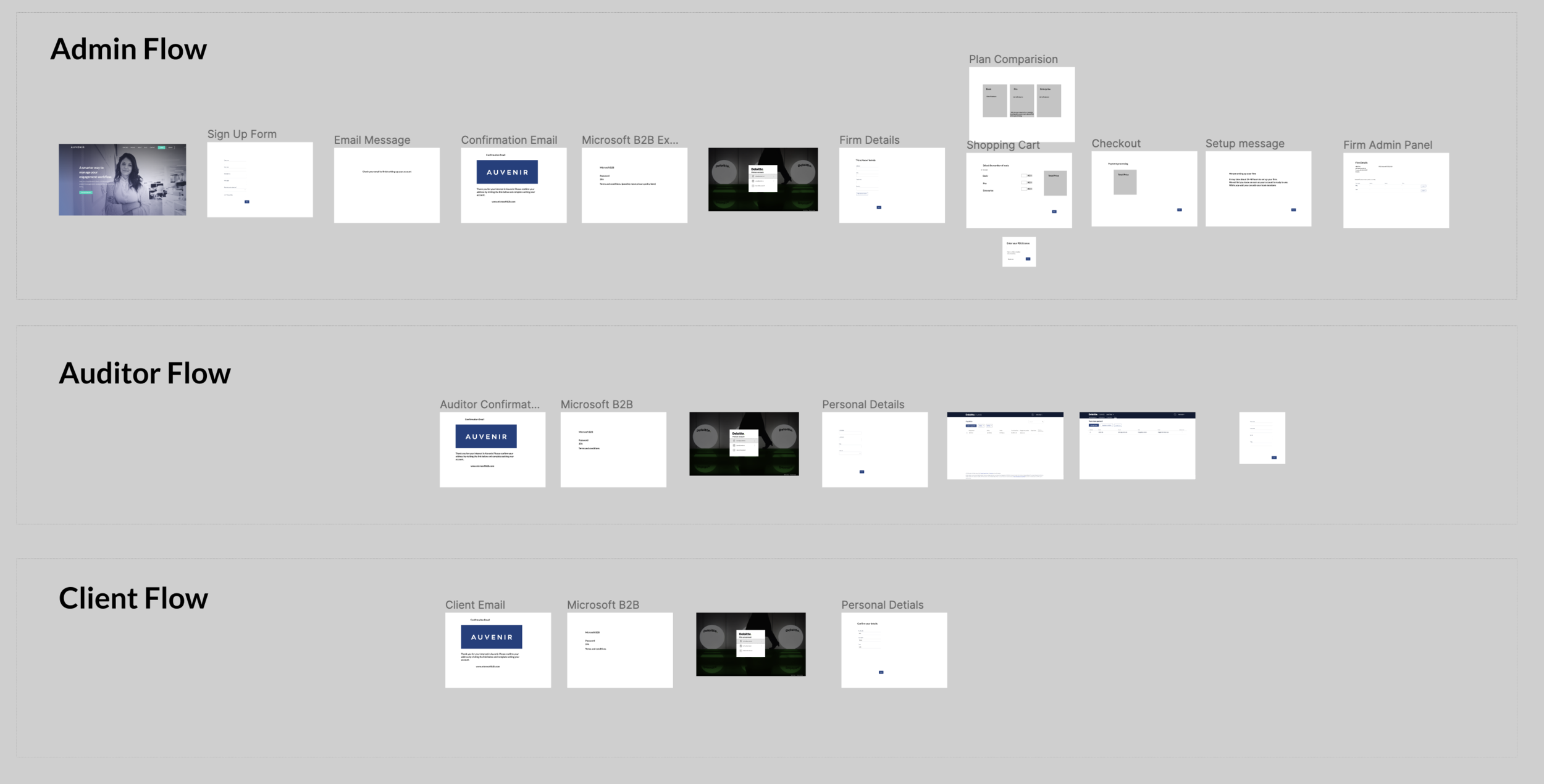
Low fidelity designs
Pain points
Content Verification
To avoid liability, Auvenir does not provide content for these auditors but rather supplies content to auditors from which they have licenses for. This means we need to check that the firms signing up have existing licenses with the content providers or send them to the content provider to purchase a license. Another limitation we have is that confirming any license number is a very manual process. Content providers don't have an API or database we could simply search against to validate. In speaking with our customer success team, they also had concerns over users not readily having this content license number available.
After looking for a solution how to make the sign up process smoother, I came up with the idea to skip this process altogether. Because our pricing model at this point was still undecided, we could potentially purchase the license on behalf of the firms. In terms of the total cost to the end-user, it would be a minimal increase. We could still perform the license check manually at a later stage and only remit the money for firms who did not have the license. This allowed us to smooth out the onboarding flow and reduce the friction of an additional step.
Independence check
The main investors of our company want to restrict large firms as well as firms who may present risks to Auvenir to be barred from signing up. Unfortunately, there is not a finite deny list available for us to block firms onto the platform. We would need to send the details of the firm to be checked manually to an external group that would handle this check. While we negotiated a 48-hour turnaround on this process, it means we need to provide an explanation to the user as to why they don’t have immediate access to the platform.
I personally had experience with a few financial applications that had to perform verification before entry into the platform. I examined some of them to see if we could draw inspiration. We needed to avoid calling out why someone would be declined from a legal perspective as well as provide a sufficient reason to slow down the process. The approach we decided to take was to capture the information to do the check as early as possible and then to provide a reason for the delay. The copy and page design was highly important.
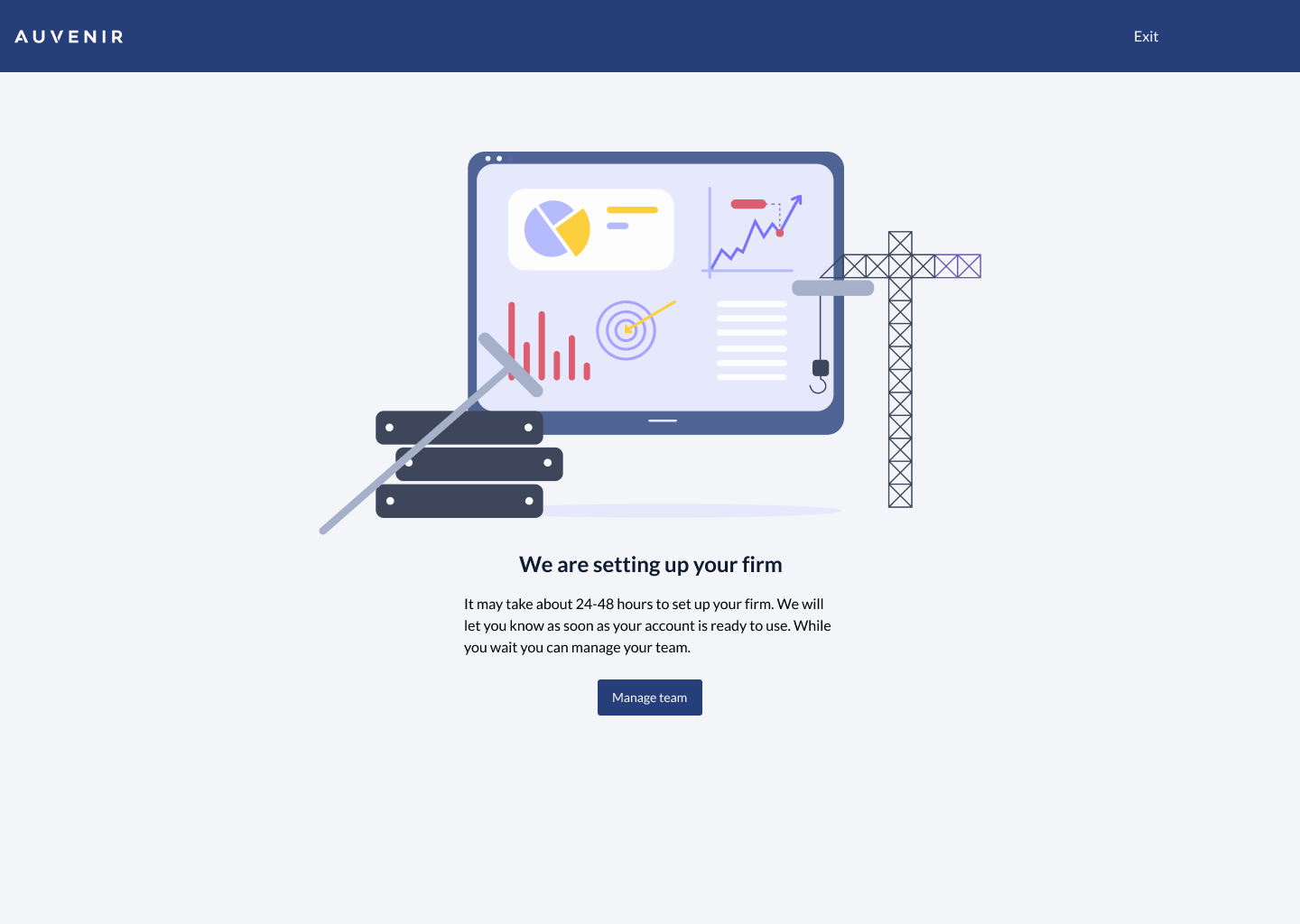
Proposed landing page after signing up. During this time we would perform an independence check.
MVP
Once we had a full flow mapped out, we understood that within the development hours we had, this would not all be possible. Our next step was to break down our ideal flow and balance what could be achieved and what needed to be done to allow us to scale up to our ideal state. The foundation on the backend needed to be built to support our infrastructure and with limited hours left, we decided to propose a change to our low-touch online sales model to be a little more high-touch.
We wanted to ensure we used our development time efficiently and limit the amount of throw away work. We ended up deciding on removing our online payment and registration. Instead, the CTA on our marketing page would be to register interest in the product. We would capture all information regarding the firm upfront so we could start the independence check, while our customer success team would complete an offline sales process. One of the reasons we felt this was the appropriate approach was looking at some of our competitors, and they involved contact with a salesperson.
Once the sales process was complete, we decided to build a customer success panel where the customer success team could add users to the platform. This allowed the CS team to manage their account types, add and remove users, and change any details. We believe that this was needed to be built regardless of the sales approach as we needed a way to manually override and change things for different edge cases like failure to pay or need for customer support.
While for our first version went with a more manual and offline apporach we still were able to address the two painpoints we identified. The first was removing the need to content verification, we purchase on behalf of the client and remove that step altogether. The second was capturing all the information needed to perform the background check as early as possible. This would allow us through the flow and for it to not be the bottle neck on the sign up process. By the time the user is taken through the whole sales process the check should have been completed.
Final flow for onboarding user to the platform
Conclusion
I enjoyed the learning experience from working on this feature. It was difficult to manage different stakeholders and their requests while creating the best experience for the user. We started off thinking of our best case scenario and breaking down the flow for what could be done now and what can be done in a later version. We were able to present these cases to get stakeholder’s buy in and challenge some of their demands to be implemented later. It took negotiation and creative problem solving skills to help relieve pain points for the end user like content license verification.